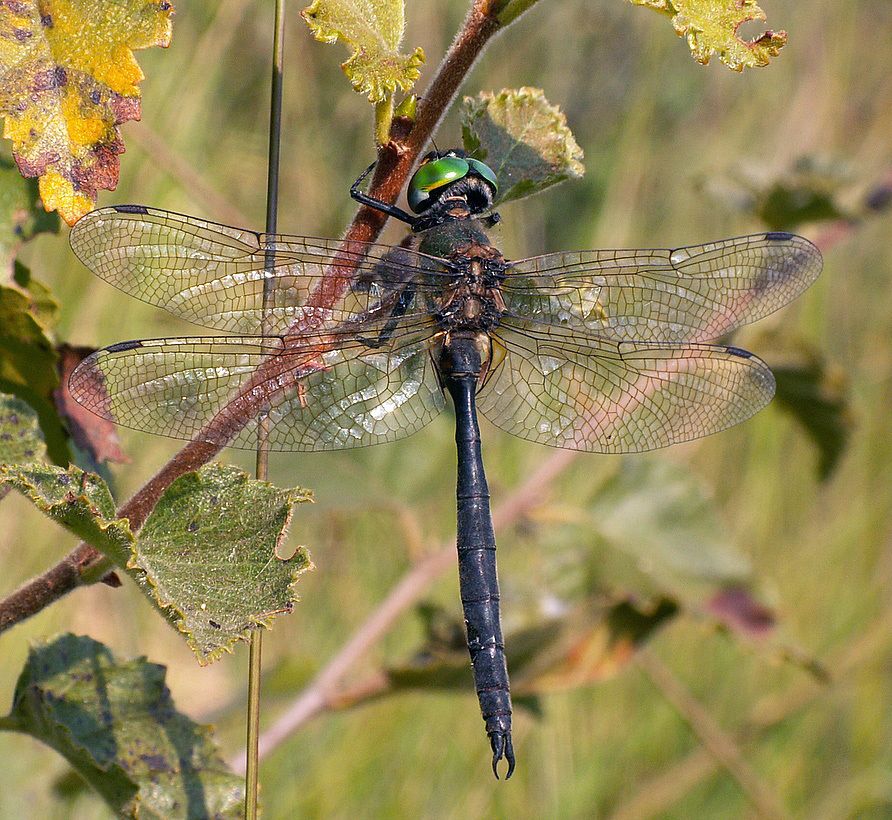
Northern Emerald
Somatochlora arctica
The northern emerald is a species of emerald dragonfly found in northern and middle Eurasia. The species was first described in 1840 from Scandinavia. It is a relatively small dragonfly, just 4 to 5 centimetres long, and is recognizable by its hairy thorax, dark abdomen, and bright green eyes. The males have narrowly waisted abdomens, while the females have straight ones; the females are also recognizable by the two lateral yellow spots behind the thorax. Northern emeralds pass two years as larvae in sphagnum-rich bog pools before emerging as adults which hunt above peat bogs, wet meadows, and open woodlands. Despite being assessed as a least-concern species by the IUCN, northern emeralds are threatened by habitat loss caused by human activity, and climate change is expected to exacerbate the problem. The northern emerald is found from Japan and the Kamchatka Peninsula through much of Russia. It is abundant throughout Fennoscandia, and is also well-known from the Alps and the Scottish Highlands. Its distribution in lowland Europe is sparse, but the dragonflies can be hard to find and record.
- Scientific name
- Somatochlora arctica
- Family
- Corduliidae
- IUCN status
- LC